 ReviewFold
Guide · Competitor research
How to Find Feature Requests in Competitor App Reviews
To find useful feature requests, start with a topic, read each review behind it, separate requests from complaints, and check what the app already offers. A topic count is a starting point for investigation — not a list of features to build.
- App
- Remini
- Store
- App Store · US
- Sample
- 200 reviews
- Collected
- Oct 21, 2026
- Review dates
- Aug 20–Oct 20, 2026
A saved, partial report. This walkthrough examines one selected theme in detail and one separate single-review lead; it does not audit every review. Remini is a third-party app; ReviewFold is not affiliated with or endorsed by it.
The theme is an entry point, not an answer.
The report grouped 24 reviews under “Paywall replaces free ad option.” Reading the original text revealed several different claims.
One reviewer asked for the app to be free “with just adds.” Another wanted a previously available ad-supported path fixed. A third asked for an older version back. Other reviewers described changes to access, complained about payment, or said an ad-supported option was still available.
Those statements belong in the same investigation. They are not interchangeable requests.
Request 01Ad-funded access
“make it totally free with just adds”
Request 02Restore a path
“watch an ad without having to pay”
Request 03Restore an older flow
“until you bring back the old version”
Three different requests: add an ad-funded option, fix an existing ad-supported path, and restore an older saving flow. Together they raise an access question; this article does not count them as one demand.
Four groups, not one request.
An editorial pass over the same 24 candidates sorted them into four working groups. The numbers describe this review — not the app’s users.
Editorial review of 24 candidates
24candidate reviews
- Requests 3
- Change reports 5
- General complaints 10
- Excluded / adjacent 6
Each cell is one review under the saved theme. The grouping is editorial; it is not the model’s theme membership.
Requests
Add ad-funded access, fix an ad-supported path, or restore an older saving flow. They are different asks.
Change reports
Reported or questioned a change to an ad-supported free path, without the same explicit request.
General complaints
Payment or blocked access, with too little detail about the ad-supported path to treat them as requests.
Excluded / adjacent
Contradictory or adjacent experiences that do not support the narrow claim that the option was removed.
24 is the model’s theme membership. 3 / 5 / 10 / 6 are categories from a Codex-assisted editorial review of those candidates. None of these numbers is a demand estimate, a quality score, or an audit of the whole report.
Counter-evidence
“watch an ad, or pay for the subscription”
One review can contradict the story.
This reviewer describes both options. That is evidence against reading every complaint as a missing ad-funded path.
The reviewer may be describing a different task, version, plan, or experience. The next step is to investigate those differences, not force the review into the dominant story.
For every candidate: keep the original review, your interpretation, and a short reason for including or excluding it.
Next step, not a finding
Turn the evidence into a question you can test.
Instead of “users want everything free,” ask:
Can occasional users find and complete the editing or saving task they expect through an ad-supported path?
- 01
Check the current app
Look at the current app and its official help for the relevant platform and plan. Do not infer today’s access rules from old reviews.
- 02
Observe the task
Watch someone attempt the editing or saving task. Note where they look, what they expect, and where they stop.
- 03
Name the difference
Distinguish a missing option from an unclear entry point, a blocked screen, or a feature-specific restriction.
This is the next investigation, not a completed test. It could lead to a usability change, clearer messaging, a different access option — or no change. Review frequency alone cannot decide the business model.
A single review can still be a lead.
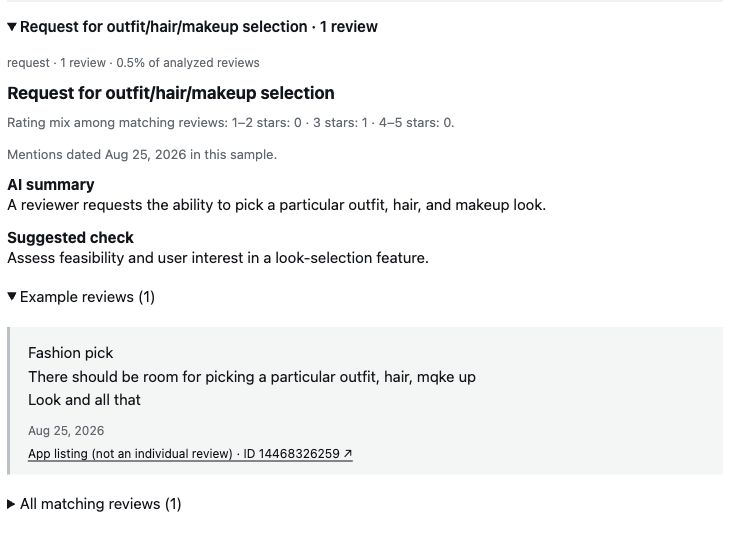
A lead from a different saved Remini report: one three-star review requesting outfit, hair, and makeup choices.
It is a specific lead worth investigating, even without repeated mentions. Keep it as a separate question; do not combine it with payment complaints to manufacture support.
“There should be room for picking a particular outfit, hair, mqke up Look and all that”
Separate lead: 1 of 200 Remini reviews in a different saved report, also collected Oct 21, 2026. This screenshot and its count belong to that report, not the report used for the 24-candidate theme.
Try it on one app
Use the report to organize the investigation.
ReviewFold groups app feedback into themes and keeps the source reviews available to inspect. Use those groups to decide what to read next, then verify the interpretation before prioritizing work.